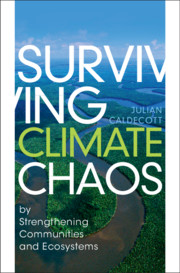
Surviving Climate Chaos is being published into a new world of lethal fires, floods and record-breaking temperatures, as well as frantic international negotiations before CoP 26 in Glasgow. This is while the IPCC warns us that we are in the last decade before Arctic, oceanic and equatorial tipping points take all choices out of human hands. This emergency calls for far greater focus and impact in our climate change response, and for the strengthening of communities and ecosystems everywhere against climate chaos.
Julian Caldecott’s new book, Surviving Climate Chaos by Strengthening Communities and Ecosystems, is published by Cambridge University Press. See my author page, and book blogs: fierce chaos and tipping points; death spirals and deadlines; the ambition to survive; chaos, strength and community, systems adapting to change, the power of cultural differences; the need for good leadership; leaving no one behind; why climate change is wicked hard; surviving climate chaos at CoP26; strengthening systems against climate chaos; Lost Species Day 30 November 2021; International Mountain day 11 December 2021; and surviving climate chaos and promoting peace with nature.
Abstract. “Surviving climate chaos requires communities and ecosystems strong enough to cope with the near-random local impacts of climate change. Their strength depends upon resilience, resistance and flexibility, three consequences of system integrity. Preserving and restoring the integrity of communities and ecosystems is needed everywhere, and quickly since active Arctic, equatorial and oceanic tipping points threaten total climate breakdown. This might be postponed by extreme efforts to conserve carbon-dense ecosystems, decarbonise economic systems, and recapture GHGs, but climate chaos everywhere is now inevitable. Adaptation efforts by 158 Paris Agreement Parties reported since 2015 are converging on community-based and ecosystem-based strategies. Case studies in Bolivia, Nepal and Tanzania confirm that these are correct strategies for surviving climate chaos, where success depends upon local empowerment through forums, ecosystem tenure security and environmental education. This approach, when replicated, networked and shielded by governments, offers the best way to strengthen societies against climate chaos while achieving the SDGs. Its usefulness is highlighted for national and local government officials and aid professionals with key roles in promoting adaptation, for students, researchers and teachers, and for all people who live under threat of climate chaos.”
Some highlights from the text:
- On culture. From cases such as Hawaii (1778-1898), Iceland (1000-1262), the Holy Roman Empire (800-1806), Ancient Rome, the EU and Brexit: “Consistent differences between cultural zones in the enthusiasm of their peoples for complying with externally-agreed standards of behaviour may be legacies of deep historical experience. This is all relevant to aid programming, since it implies that taking the time and making the effort to build and educate in the context of the local culture, and creating the space for local people to find their own answers at their own pace, may well yield more robust and durable solutions than programming against imposed deadlines can possibly achieve.” (pages 79-80).
- On leadership. “A particular risk arises where important environmental and social signals cannot be appreciated without a great deal of knowledge and attention to detail, so they are recognised only by a small minority. This applies often in large, complex or fragmented societies in which there are many distractions, and especially where slowly deteriorating environmental conditions are involved, or where there are slowly growing social threats such as inequality, corruption and polarisation. Here, if the danger is severe and solutions are needed urgently but there is little public appreciation of the need for action, an essential quality of leadership is a willingness to act decisively to safeguard the group but in advance of public opinion. An accountable leader must then explain what happened in the emergency and why, and be willing to accept responsibility for all the consequences. A good leader must at least be competent, attentive, intelligent, articulate and flexible, but all candidates for leadership are likely to claim all these attributes, so the choice will be up to the electorate. The latter might be expected to be on the look out for stupidity, cupidity, criminality, extremism, narcissism or a tendency to lie, since these often-concealed attributes can endanger everyone. With climate change, it would also make sense for voters to prefer leaders who understand ecology, at least to the extent that they can be trusted to grasp the basic ideas of where food, water and environmental security come from, and what climate change might mean for these necessities. Such knowledge can easily be tested at interview or by questioning during campaigns, but ecology is still seen as a minority interest rather than something that every citizen and journalist should know about. It is not feasible for leaders who are competent on climate change to be chosen consistently while this lack of interest in ecology persists. This is why the universal early teaching and learning of ecology is necessary to adaptation leadership, and therefore to adaptation itself.” (pages 81-82).
- On leaving no one behind. “The most reliable, cheap and equitable way to ensure than no one is left behind is for individual hardship to be detected by other people – neighbours rather than machines, companies or functionaries of the state, and acted on by them alerting public services and monitoring the response. This offers a way to implement reliably policies of equity that require neither states nor corporations for their primary effectiveness. The key issue then becomes how to ensure that nations and corporations support and enable the operations of small groups, rather than replacing them with larger-scale systems that conflict with the ordinary sociability of our species. This choice, of whether to work with organic society or replace it with a machine state, is fast becoming urgent as the technology needed for universal surveillance is developed by corporations and bought by governments.” (pages 83-84).
- On climate change mitigation. “Although what we should do in practice has long been obvious in general and precautionary terms, the existence of uncertainty inevitably fed controversy, and controversy has favoured the rich and powerful who often have least interest in promoting change. The whole thing has been described as a ‘wicked’ problem, being deeply complex, intractable, and resistant to solution, but an independent observer might say that we have added to this ‘wickedness’ through unclear intentions, political naïveté, and a specious faith on our own knowledge and ability to understand and predict the behaviour of extremely complex systems.” (pages 204-205). “The mitigation problem cannot be solved by any one country, and there is no all-knowing, global ‘hegemon with the power to impose a single set of rules’ (Chapter 1). Only nature could have that role, in wielding infinite power and universal rules, but this is seldom acknowledged. International cooperation is therefore essential, and this has fallen foul of multiple sources of reluctance to cooperate, rooted in historical, cultural and economic experiences, rivalries and reasons for distrust, ranging from slavery, trade and religion to imperialism, ideology and war. … The slow and painful process of the UNFCCC and its gradual, erratic progress towards approximate agreements on fixing the mitigation problem, is the compromise solution that has gradually been squeezed out of the tension in the UN system between everyone knowing that something must be done and no one being willing to pay for it.” (page 309).
- On strengthening systems. “By assigning to local people clear, long-term rights to own, manage and benefit from ecosystems, they will become more interested in the condition of those ecosystems. By also establishing ecosystem management groups or forums where people can agree how to manage the ecosystems for which they are responsible, the ecosystems will tend to be managed in line with agreed locally-perceived priorities. Because of long-term tenure, community responsibility and forum accountability, these priorities will usually include an interest in the long-term supply, and hence sustainability, of a selection of ecosystem goods and services, for collective rather than private benefit. The forum itself will also preserve, restore or introduce practices of debate and consensus building within the empowered community. Some of these effects (e.g. biodiversity conservation, catchment services, carbon storage, conflict reduction, poverty avoidance) will also be appreciated as benefits by national society, creating an incentive among national stakeholders to support and replicate the community empowerment process. Some national benefits may be seen by outsiders, because of their different priorities, as unlikely to be adequately addressed or developed by local people, creating an incentive to improve local ecological knowledge by offering technical support, environmental education and networking with other communities where similar issues have been resolved. The net result of secure local tenure, local forums, and outside support offered but not imposed (i.e. without consent or compensation), will be healthier ecosystems and more engaged and confident local people (i.e. stronger systems) at landscape level, and improvements to governance and environmental security at the national level, as a result of which the whole country will be better able to cope with climate chaos.” (page 285).
- On understanding the challenge. “Never before has an animal species single-handedly destabilised its own habitat at a global level, and in the process brought to a halt the evolutionary trajectories of millions of other species. We are doing this while also applying the full force of investigative and analytical technology to document and explain events and foresee outcomes, and also while in full possession of enough advanced ecological and anthropological knowledge to make sense of what we are seeing. The adaptation communications are an ever-deepening ocean of knowledge to which any student, researcher or teacher should be drawn at this, the most interesting and desperate time in human history.” (page 322).
- On the role of small groups. “A small group can be potent if it wants to be, and partnerships are vital. There is nothing to stop everyone on Earth becoming an active part of the climate response by joining with others to make a difference. We are social animals and can achieve nothing outside of social systems, including the saving of the ecological systems on which we all depend. And one of the ways that a small local group can make a real difference is by joining forces with others to enact change and to insist on it. The more groups there are, and the more they talk with each other, the more valuable they all become, to each other, to local and national governments, and to the future.” (page 323).
© Julian Caldecott, 2021